
Ontonagon Court Records After Arrest
In Ontonagon County, a court record after a jail arrest is not the same thing as a jail log. The local custody path usually starts with booking at the sheriff's facility, then moves to prosecutor review and a first court appearance. The Ontonagon County Prosecuting Attorney decides what charges to authorize or file. The official county page names Rudolph Perhalla as Prosecuting Attorney and lists the office at the courthouse. Once a complaint or other charging paper is filed, the charge becomes part of the court case record.
The Ontonagon County Sheriff's Office is still the first local contact for a very recent arrest, especially because no official online jail roster was located. The court side answers a different question. It shows the filed offense, case number, hearing path, bond conditions, amendments, dismissal, plea, verdict, or sentence. For current custody and booking information, the better starting point is jail inmate records. For booking photos, use the jail mugshots page rather than assuming a court file will show a photo.
From Booking to First Court
The arrest to court path in Ontonagon County is built around several local offices. The jail record begins with arresting paperwork from law enforcement. The prosecutor then reviews the case and decides which charges to authorize. Early criminal proceedings are handled through Ontonagon County District Court, whose official page lists Judge Michael D. Findlay, Magistrate Sarah Anderson, Probation Officer Paula Domitrovich, and phone 906-884-2865. Felony cases may later move to Circuit Court, where the official county page lists Judge Michael Pope and the Clerk/Circuit Court phone context of 906-884-4255.
That sequence means a person may be in the Ontonagon County Jail before a public electronic court case can be found. A name search can fail if booking just occurred, if arraignment has not happened, if the court does not expose that record online, or if the case is sealed or restricted. When the case does appear, the court record should be read as the case file, not as proof that the person is still in jail.
Practical flow: arrest, jail booking, prosecutor review, first appearance or arraignment, bond decision, case tracking, then disposition. A disposition is the final result for a charge, such as conviction, dismissal, or other court action.
Search MiCOURT After Arrest
MiCOURT Case Search is the statewide public case-search portal for Michigan courts where public electronic records are available. The research did not confirm a sample Ontonagon criminal record inside the live portal, so the safe rule is to search by name or case number when the court is available and then call the court if the result does not appear. The Michigan Courts case search entry page also points users toward public case, opinion, and order resources.
The captured MiCOURT screen from the Michigan Courts portal shows why spelling and court selection matter when looking for Ontonagon County court records after an arrest.
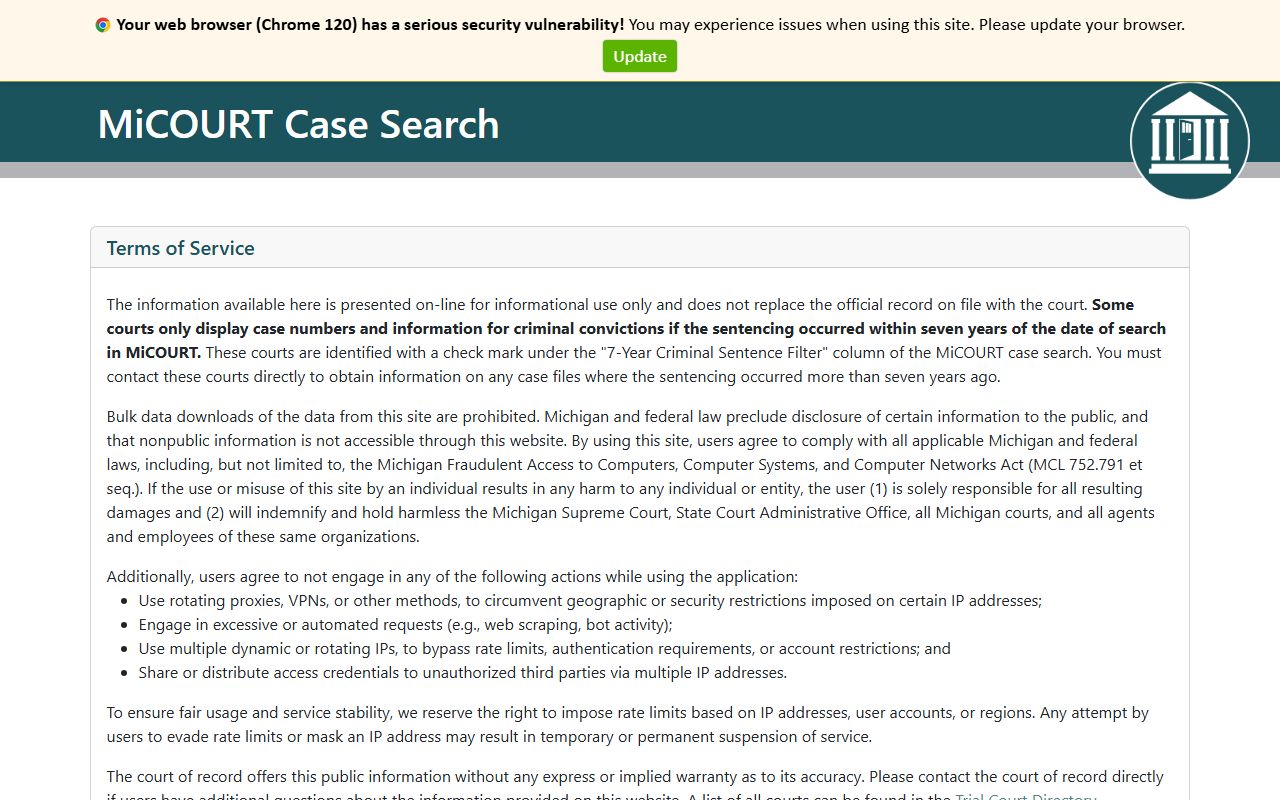
Use the case number from court paperwork, a bond receipt, or a hearing notice when possible. Name searches are useful but less exact. If a person was booked under one name and charged under another legal name, the court clerk may be the better source for the case number.
| MiCOURT Field | Use | Search Note |
|---|---|---|
| Court | Select the court or county where available. | Participation and record display can vary by court. |
| Case Number | Search a known criminal case. | Best when copied from a notice, receipt, or docket entry. |
| Party Name | Search by defendant name. | Try legal names and spelling variants. |
| Case Type | Filter to criminal or traffic-criminal matters. | Exact options can vary by portal state. |
| Date of Birth | Refine a criminal name search if requested. | Use the format shown by the portal. |
Ontonagon Arrest Charging Records
Formal court records after a jail arrest turn on the charging document. The jail may enter arrest or booking charges from the officer's paperwork, but the prosecutor-filed document controls the court case. A complaint is the usual starting document for many criminal matters. An information can be used in felony practice after early proceedings. An indictment is less common in routine local cases but remains a charging method tied to grand jury action.
For Ontonagon County cases, the Prosecuting Attorney is the local charging authority. Prosecutor staff may not discuss pending cases with nonparties beyond public information, so public case status is usually checked through MiCOURT, the court clerk, or records available at the courthouse.
| Document | Who Files It | What It Does |
|---|---|---|
| Complaint | Prosecutor, often based on officer reports. | Starts many criminal cases and states the formal accusation. |
| Information | Prosecutor. | States felony charges after the case moves beyond early district-court proceedings. |
| Indictment | Grand jury process. | Charges a serious matter through grand jury action when used. |
Ontonagon Charge Status Records
Charge status can change as a case moves through court. A booking charge may be amended, reduced, dismissed, bound over, or resolved by plea or trial. That is why court records after an arrest should be checked by charge, not just by the first arrest label. A status term describes where that charge stands at the time the court record was updated.
| Status | What It Means | Why It Matters |
|---|---|---|
| Pending | The charge has not reached final disposition. | Hearing dates, bond, and conditions may still change. |
| Amended | The formal charge was changed by filing or court action. | The amended charge may differ from the booking label. |
| Reduced | The charge level or offense was lowered. | Disposition and sentencing exposure may change. |
| Dismissed | The charge ended without a conviction on that count. | It is not the same as a guilty finding. |
| Bound Over | A felony case moved from District Court toward Circuit Court. | Search both court levels if the case advanced. |
Bond Records After Arrest
Bond is a court issue, even when a person is physically held at the jail. Ontonagon County research did not locate a sheriff page that explains online bond payment. District Court materials mention online debit or credit card payment for district-court fines, and Circuit Court materials mention court-related fee and fine payments, but those references should not be treated as jail bond instructions. For a live bond question, call the sheriff/jail at 906-884-4901 first, then contact District Court at 906-884-2865 or the Clerk/Circuit Court channel at 906-884-4255 if the case has moved there.
| Bond Type | Plain Meaning | Ontonagon Record Cue |
|---|---|---|
| Personal recognizance | Release based on a promise to appear and comply. | Look for release conditions in the court order. |
| Cash bond | Money is posted to secure future court appearances. | Confirm the amount and payment location before paying. |
| Surety bond | A lawful bond agent posts surety where permitted. | Verify the court order and any holds first. |
| No-bond hold | Release is blocked until a court or holding agency acts. | May involve warrants, parole or probation, federal matters, or ICE. |
Warrants and Court Arrest Records
No official Ontonagon County active-warrant search page or most-wanted list was located on the county or sheriff site. A warrant that leads to an arrest may be an arrest warrant, a bench warrant for failure to appear, a warrant or hold from another jurisdiction, or a search warrant tied to an investigation. Only some warrant-related information may be public before service, and active law-enforcement records can be limited.
The practical access path is phone first. Call the sheriff/jail at 906-884-4901 or the court that issued the warrant. For District Court matters, use 906-884-2865. For felony or post-bindover Circuit Court matters, use the Clerk/Circuit Court contact at 906-884-4255. If a person may have an active warrant, voluntary appearance, bond options, and legal advice should be handled through the court, counsel, or sheriff instructions.
Charges vs Convictions
A charge is an accusation. A conviction is the result of a guilty plea, verdict, or other adjudication that establishes guilt for a count. Court records after a jail arrest may show both, but they should not be read as the same event. This is especially important in Ontonagon County because a booking charge from the jail can differ from the charge that the prosecutor files.
| Point | Charge | Conviction |
|---|---|---|
| Stage | Filed accusation in court. | Final result after plea, verdict, or adjudication. |
| Proof | Based on legal grounds to accuse. | Requires the criminal standard for guilt or a valid plea. |
| Status | May be pending, amended, reduced, or dismissed. | Creates a conviction record unless later set aside or otherwise made nonpublic. |
Sealed and Expunged Records
Michigan law uses set-aside rules for eligible convictions and certain records. The research points to MCL 780.621 for set-aside and expungement questions. A public search may not show sealed, restricted, juvenile, or otherwise nonpublic material. A dismissal also does not guarantee that every related record vanishes from every system at the same time.
| Point | Sealed | Set Aside or Expunged |
|---|---|---|
| Public View | Hidden from general public access. | Treated as nonpublic under the controlling order and statute. |
| Agency Access | Some official access may remain. | Some limited official access may still exist under law. |
| Best Source | Ask the court clerk about record access limits. | Review the court order and Michigan set-aside law. |
Public Access and Copy Requests
Michigan FOIA provides a written-request fallback for existing public records held by public bodies, subject to exemptions and lawful fees. For jail records, the local public body is usually the sheriff. For filed criminal case papers, the court clerk is the better route. For state police records, the Michigan State Police FOIA page explains statewide request methods, including portal, email, fax, and mail options. Requests should describe the person, date, agency, case number if known, and the specific record sought.
Important: This resource is not a consumer reporting agency and must not be used for employment, tenant, credit, or insurance screening.
Public Record Search
Sponsored Results